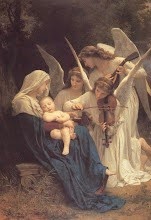
Why does the Apostles' Creed include „the communion of saints“ as one of the twelve articles of faith, one of the twelve essentials of our religion? Because our fundamental vocation in life is to be saints. Because, as Charles Peguy puts it, „life holds only one tragedy, ultimately; not to have been a saint.“ Because this whole world is a saint-making machine. Because the whole purpose of creation, revelation, Incarnation, Atonement, and Church is to make us saints. Because everything the Church does, from setting up bishops to setting up chairs, from raising money to raising martyers, has no other purpose than this. Because life itself has no other purpose than this.
Saints are not far-out freaks, wierdos, or exceptions. They are the rule, the plumb line, the sandard operating model for human beings. If we are not saints, we are the exceptions to the rule, whether we make up 1 percent or 99 percent of the human race.
In the biblical sense of the word, all believers are saints. Saints are not the opposite of sinners. There are no opposites of sinners in this world. There are only saved sinners and unsaved sinners. Holy does not mean sinless but special, set apart, called out of the world to the unthinkable destiny of eternal ecstasy in spiritual marriage to God Almighty.
In the popular sense of the word, sainthood is a matter of degree: a saint us someone who does something better than most of us. What thing? One thing with three sides: faith, hope and love.
The Church's language is half biblical and half popular when she canonizes certain „saints“, i.e., solemnly declares that certain known and named persons are both in heaven and worldly models for our earthly imitation. The modern world is a world without heroes. Saints are the answer. Saints are the true heroes.
Sunday, October 25, 2009


Thursday, October 22, 2009
Poustinia
Poustinia is "an entry into the desert, a lonely place, a silent place, where one can lift the two arms of prayer and penance to God in atonement, intercession, reparation for one's sins and those of one's brothers.... To go into the poustinia means to listen to God. It means entering into kenosis — the emptying of oneself." (Catherine Doherty, Poustinia)
To be still is a great exercise of soul, to be quiet and surrender one's mind and thoughts. Our lives today are filled to the brim with noise, and rightly so, for the mandates of this life we live demand far more rapid and attentive devotion then did the lives of our Fathers. It is a necessary condition of our time, but one that may become all consuming when considered as an end unto itself.
There is a need in man for quiet, where he may go to rest his body, weary from manual labor, and his soul, weary from the tangle of his mind. Robert Bolt once said that "God made man to serve him in the tangle of his wits" and so it is with us today, but this does not deny, nor lessen in any way our continual need for peace. We are creatures of great passion, but who become very tired, very tired indeed. Deep in his roots man has a need for the ultimate peace, who is Jesus himself, and when we try to fill our need for God with transient and unfulfilling things, he leads himself along a short route to supreme unhappiness.
For that is what a disquiet soul experiences, unhappiness. When the human person fails to reach his full potential, his conscience is fully cognizant of this, even though his consciousness may be partially unaware, and he is disturbed. Our souls were made to be a constant output of love, and when cut off from a source of replenishment, we cease being able to give. Like a stream must be fed from a plentiful source before it can water the fields and flowers who thrive on its rivulets, so we too must have ourselves a well-spring of happiness, else we become choked up and dry. Without peace in our souls we can not give it to others.
This dryness is completely abhorrent to our nature, which is to be a giver. Without giving of ourselves, we can not be who we are meant to be, and thus wither away, unable to reach our full potential as humans. We must go into the Poustinia, into the great silence, in order to find our replenishment, to find our source of life and peace. We must be still and listen to the quietness, a silent retreat to be refreshed and to offer thanksgiving to the spring of our peace.
A quiet of soul, yes, and a rest of body. We are our bodies as much as we are our souls, and they are in sorry need of rest as well, sometimes more. We have a tendency to forget the need of our bodies for rest (though we feel it most apparently), for our souls are immortal and our bodies shall die, and thus many choose to forgo the replenishment of a bodily need. What must never be forgotten is that the soul and the body are inseparably linked. Without adequate rest for the body, the soul will also be disquiet and disturbed, unable to find rest in the weariness of its fleshly self. Therefore it is necessary that one find rest for the body as well as for the soul, and continually.
Continually I say, because the human must continue to be replenished. It is no good giving him a single dose of rest and sending him on his way. Peace is not a vaccination against unhappiness, it operates in a continuous flow, or doses, so that one might never be exhausted or spent, but can give and keep giving without reserve. The well-spring of peace is never exhausted, so drink in, and drink deeply.
To be still is a great exercise of soul, to be quiet and surrender one's mind and thoughts. Our lives today are filled to the brim with noise, and rightly so, for the mandates of this life we live demand far more rapid and attentive devotion then did the lives of our Fathers. It is a necessary condition of our time, but one that may become all consuming when considered as an end unto itself.
There is a need in man for quiet, where he may go to rest his body, weary from manual labor, and his soul, weary from the tangle of his mind. Robert Bolt once said that "God made man to serve him in the tangle of his wits" and so it is with us today, but this does not deny, nor lessen in any way our continual need for peace. We are creatures of great passion, but who become very tired, very tired indeed. Deep in his roots man has a need for the ultimate peace, who is Jesus himself, and when we try to fill our need for God with transient and unfulfilling things, he leads himself along a short route to supreme unhappiness.
For that is what a disquiet soul experiences, unhappiness. When the human person fails to reach his full potential, his conscience is fully cognizant of this, even though his consciousness may be partially unaware, and he is disturbed. Our souls were made to be a constant output of love, and when cut off from a source of replenishment, we cease being able to give. Like a stream must be fed from a plentiful source before it can water the fields and flowers who thrive on its rivulets, so we too must have ourselves a well-spring of happiness, else we become choked up and dry. Without peace in our souls we can not give it to others.
This dryness is completely abhorrent to our nature, which is to be a giver. Without giving of ourselves, we can not be who we are meant to be, and thus wither away, unable to reach our full potential as humans. We must go into the Poustinia, into the great silence, in order to find our replenishment, to find our source of life and peace. We must be still and listen to the quietness, a silent retreat to be refreshed and to offer thanksgiving to the spring of our peace.
A quiet of soul, yes, and a rest of body. We are our bodies as much as we are our souls, and they are in sorry need of rest as well, sometimes more. We have a tendency to forget the need of our bodies for rest (though we feel it most apparently), for our souls are immortal and our bodies shall die, and thus many choose to forgo the replenishment of a bodily need. What must never be forgotten is that the soul and the body are inseparably linked. Without adequate rest for the body, the soul will also be disquiet and disturbed, unable to find rest in the weariness of its fleshly self. Therefore it is necessary that one find rest for the body as well as for the soul, and continually.
Continually I say, because the human must continue to be replenished. It is no good giving him a single dose of rest and sending him on his way. Peace is not a vaccination against unhappiness, it operates in a continuous flow, or doses, so that one might never be exhausted or spent, but can give and keep giving without reserve. The well-spring of peace is never exhausted, so drink in, and drink deeply.
Why I am a Catholic
Sanity is defined as how closely ones belief of how the world operates coincides with how in reality the world works. This blog is about my beliefs on humanity and how sane or insane these beliefs prove themselves to be. To begin, an examination of my beliefs are necessary. I believe in the Holy Catholic Church, and all that it professes, because it is the only belief to answer my questions on the dignity of humans, the nature of suffering and the social nature of man, in such a way as to convince me of its truth and faithfulness to reality. Therefore I shall now examine how the Church answers these convictions in a way consistent with reality.
My first objection to Christianity came in the form of humans themselves. I had difficulty accepting the idea that man are created in the image and likeness of a god. What god is there that kills innocent children for fun? How can a creature capable of such terrible and horrid things as man be loved, even created by a being. My problem was I couldn't love man with sin, so I hated him. I found man a disgusting creature to be reviled and hated and controlled. The Catholic understanding of evil answers me with the salvation story, that man was created good, and that he fell. That sin is no real tangible thing which we humans possess, but a lack of something which compels us to act in this disgusting manner is as shocking and wonderful a revelation as one may ever find. That means that man, inherently, is not a despicable creature. It means that he is a pitiable creature, possessing the fullness of glory in him at the same moment he wallows in the mire of his own sin. I think it is only possible to truly love mankind when one has adopted this understanding of humans, otherwise one has to ignore human evil entirely, or hate humans. Some people deny Auschwitz in their minds, because they can not accept the idea of humans doing such awful things to each other. Islamic law requires the presence of at least two male witnesses to prove rape, because they somehow believe that a men can't take advantage of a woman unless she submits. This is a denial of reality, a denial of man's sinfulness, and one has to deny it in order to love man. Without a Christian love for man, which recognizes man as a sinless-created, but entirely sinful creature in need of salvation, I truly think a love of humankind in general is impossible. One has to accept that the abysses of Sodom and Divine Glory exist side by side in the human person before one can love them, or themselves.
But what about suffering? If God truly came down and died for us on the cross, shouldn't we be cured of the need for suffering? If the redemption happened, why do people still die, or did Jesus not truly conquer death? The Catholic Church answered me again with the profession of redemptive suffering. The truth is that the resurrection is not an event, it is a process, one which takes place in the hearts and minds of all human beings. This continual death through suffering is the method in which men become spiritually mature, and through which they attain salvation. Jesus says “Whosoever wishes to live must take up his cross and follow me” and then again in John, “I am the resurrection and the life, whosoever liveth in me, though he die, shall have eternal life.” The death to self and to the world is suffering, and it is suffering which brings us closer to God. Throughout the entirety of the Old Testament, the Hebrews are continually rejecting God and he then inflicts horrible cataclysms on them to necessitate their return. In the same way, all humans receive suffering as the path onwards to a higher end. Humans must continually die to their ideas, to their thoughts and to their dreams. Humans must always die every day to old addictions and to old fears, and out of the ashes there must rise a new man. The phoenix of mythology is a metaphor for the human experience, for just as the phoenix was consumed by its own flames, so too must men be consumed by their theories, actions, and desires, rise again from the ashes of his weak and former self, and rise to scale their mountains. Buddhism teaches that suffering is an illusion. Well that would be nice, but entirely foolish to believe. The murder of innocent children is no illusion, the rape of defenseless women is no illusion. It happens. Atheists have to believe that suffering has no redemption, and that the pain and sorrow and suffering people go through is all in vain. Hindus believe that suffering is the consequence of something you did in your past life, which leaves us to offer no compassion to those suffering. After all, the Jews must have “deserved” Dachau, must have “deserved” the gas chambers with this understanding. No. The Catholic world view is the only answer which adequately answers this dilemma for me.
The last issue to be addressed is the issue of Human Community and the Social Nature of man. I have always wondered at the truth of this statement, which is professed by the Catholic Church, and which I had to accept as the result of after many long years of attempting to live a solitary self-sufficient existence. But on the other hand, to what extent is man a communal being before he ceases to be an individual? I was always afraid of loosing my individuality in the Christian community, always afraid that my quirks and uniqueness would be squashed and squeezed out of me (which tends to happen in Protestant communities I have noticed). However, when I heard that the Catholic believed that the Community was the Church and that the individual was the Church, I was at the same time astonished and wonderfully pleased. This avoids entirely the error of communism, which eliminates individuality entirely. Or as C.S. Lewis says in the Screwtape Letters, the devil wants to claim all humans entirely, so that they loose their individuality. But this Christian God does not want drones, but his mystery is more fully revealed in the Christian Community, in fact, humans are meant to exist in communities, which coincides completely with the psychological and sociological habits of man, observable outside the context of Christianity. So in the Christian context, persons exist in full communion with each other, mirroring the communion of the Trinity, but retain their own individuality. Atheists have two different ways of dealing with the issue. Either the individual is the center of everything; self-preservation and all that, or the individual must always give way to society. So for Communism, the individual ceases to exist in the appropriation of goods, man is no longer degraded, because for a communist, a man's worth is dependent on his production, and if all are paid equally for production, worth is consistent across all men. The very aim of communism is the cesation of the individual. Hindus believe that man's individuality vanishes in complete Nirvana, where his soul dissolves in heavenly bliss in union with the universe (aka god). Christians would call that anihilation, for the individual ceases to exist. Buddhists too, are concerned with the individual reach for enlightenment, and views the individual as completely self-sufficient. The extreme of self-first philosophies denies the social nature of man, which is a psychological fact, and the extreme of the denial of individuality contadicts the very obvious nature of individuality itself. In other words, Catholicism is the world-view to acceptably combine both the community and the individual without loss of individuality or denying the social nature of man.
In Conclusion, I am a Catholic because Catholicism has stood before my accusations and answered them calmly and without fear. Catholicism answered my hatred for humanity with the truth of human nature. Christianity answered the problem of suffering, opening my eyes to the continuing resurrection all around me. An lastly, I came to accept Christian community as the fullness of worship and the design for human existence. All other forms of belief have paled under the microscope, and until I am presented otherwise, my chips lie on this table. I cast my vote with the Christian God.
My first objection to Christianity came in the form of humans themselves. I had difficulty accepting the idea that man are created in the image and likeness of a god. What god is there that kills innocent children for fun? How can a creature capable of such terrible and horrid things as man be loved, even created by a being. My problem was I couldn't love man with sin, so I hated him. I found man a disgusting creature to be reviled and hated and controlled. The Catholic understanding of evil answers me with the salvation story, that man was created good, and that he fell. That sin is no real tangible thing which we humans possess, but a lack of something which compels us to act in this disgusting manner is as shocking and wonderful a revelation as one may ever find. That means that man, inherently, is not a despicable creature. It means that he is a pitiable creature, possessing the fullness of glory in him at the same moment he wallows in the mire of his own sin. I think it is only possible to truly love mankind when one has adopted this understanding of humans, otherwise one has to ignore human evil entirely, or hate humans. Some people deny Auschwitz in their minds, because they can not accept the idea of humans doing such awful things to each other. Islamic law requires the presence of at least two male witnesses to prove rape, because they somehow believe that a men can't take advantage of a woman unless she submits. This is a denial of reality, a denial of man's sinfulness, and one has to deny it in order to love man. Without a Christian love for man, which recognizes man as a sinless-created, but entirely sinful creature in need of salvation, I truly think a love of humankind in general is impossible. One has to accept that the abysses of Sodom and Divine Glory exist side by side in the human person before one can love them, or themselves.
But what about suffering? If God truly came down and died for us on the cross, shouldn't we be cured of the need for suffering? If the redemption happened, why do people still die, or did Jesus not truly conquer death? The Catholic Church answered me again with the profession of redemptive suffering. The truth is that the resurrection is not an event, it is a process, one which takes place in the hearts and minds of all human beings. This continual death through suffering is the method in which men become spiritually mature, and through which they attain salvation. Jesus says “Whosoever wishes to live must take up his cross and follow me” and then again in John, “I am the resurrection and the life, whosoever liveth in me, though he die, shall have eternal life.” The death to self and to the world is suffering, and it is suffering which brings us closer to God. Throughout the entirety of the Old Testament, the Hebrews are continually rejecting God and he then inflicts horrible cataclysms on them to necessitate their return. In the same way, all humans receive suffering as the path onwards to a higher end. Humans must continually die to their ideas, to their thoughts and to their dreams. Humans must always die every day to old addictions and to old fears, and out of the ashes there must rise a new man. The phoenix of mythology is a metaphor for the human experience, for just as the phoenix was consumed by its own flames, so too must men be consumed by their theories, actions, and desires, rise again from the ashes of his weak and former self, and rise to scale their mountains. Buddhism teaches that suffering is an illusion. Well that would be nice, but entirely foolish to believe. The murder of innocent children is no illusion, the rape of defenseless women is no illusion. It happens. Atheists have to believe that suffering has no redemption, and that the pain and sorrow and suffering people go through is all in vain. Hindus believe that suffering is the consequence of something you did in your past life, which leaves us to offer no compassion to those suffering. After all, the Jews must have “deserved” Dachau, must have “deserved” the gas chambers with this understanding. No. The Catholic world view is the only answer which adequately answers this dilemma for me.
The last issue to be addressed is the issue of Human Community and the Social Nature of man. I have always wondered at the truth of this statement, which is professed by the Catholic Church, and which I had to accept as the result of after many long years of attempting to live a solitary self-sufficient existence. But on the other hand, to what extent is man a communal being before he ceases to be an individual? I was always afraid of loosing my individuality in the Christian community, always afraid that my quirks and uniqueness would be squashed and squeezed out of me (which tends to happen in Protestant communities I have noticed). However, when I heard that the Catholic believed that the Community was the Church and that the individual was the Church, I was at the same time astonished and wonderfully pleased. This avoids entirely the error of communism, which eliminates individuality entirely. Or as C.S. Lewis says in the Screwtape Letters, the devil wants to claim all humans entirely, so that they loose their individuality. But this Christian God does not want drones, but his mystery is more fully revealed in the Christian Community, in fact, humans are meant to exist in communities, which coincides completely with the psychological and sociological habits of man, observable outside the context of Christianity. So in the Christian context, persons exist in full communion with each other, mirroring the communion of the Trinity, but retain their own individuality. Atheists have two different ways of dealing with the issue. Either the individual is the center of everything; self-preservation and all that, or the individual must always give way to society. So for Communism, the individual ceases to exist in the appropriation of goods, man is no longer degraded, because for a communist, a man's worth is dependent on his production, and if all are paid equally for production, worth is consistent across all men. The very aim of communism is the cesation of the individual. Hindus believe that man's individuality vanishes in complete Nirvana, where his soul dissolves in heavenly bliss in union with the universe (aka god). Christians would call that anihilation, for the individual ceases to exist. Buddhists too, are concerned with the individual reach for enlightenment, and views the individual as completely self-sufficient. The extreme of self-first philosophies denies the social nature of man, which is a psychological fact, and the extreme of the denial of individuality contadicts the very obvious nature of individuality itself. In other words, Catholicism is the world-view to acceptably combine both the community and the individual without loss of individuality or denying the social nature of man.
In Conclusion, I am a Catholic because Catholicism has stood before my accusations and answered them calmly and without fear. Catholicism answered my hatred for humanity with the truth of human nature. Christianity answered the problem of suffering, opening my eyes to the continuing resurrection all around me. An lastly, I came to accept Christian community as the fullness of worship and the design for human existence. All other forms of belief have paled under the microscope, and until I am presented otherwise, my chips lie on this table. I cast my vote with the Christian God.
Palestrina
There is a soul in Renaissance music, a moving spirit which captivates me. I recently bought a CD of the Choir of Westminister Abby, and as I was listening to it, emotion was just swelling up inside of me. Perhaps it is because of the innately spiritual nature of the Missa Papae, which commands the listener to participate in it's singular act of worship and adoration. Augustine was speaking the truth when he said that to sing was to pray twice. For in singing, your entire being is offered as a steady undivided focus of the will and the body. Robert Bolt in A Man for All Seasons said, through the mouth of Sir Thomas More, that there was a faculty in man which does not serve any of his appetites, but is the Man Himself. I believe that in music we are offering our selves, our very selves, in a very personal and willful act of love. This is Beauty we are creating with our minds and our bodies, literally becoming instruments for the glory of our Creator. I can not help but be carried off with the singers, for my soul rejoices in God my Savior, and if I do not cry out, the very rocks and stones will. Our activity in singing is a perfect example of how life should be lived at every moment of our day, in total self-giving. We must give this part of ourselves fervent exercise, so to make a final present, lived in a manner worthy of the life Christ bought for us, our blood-price.
Sunday, September 27, 2009
Thank You Nagel
All my Catholic sensibilities are rejoicing at the words of Thomas Nagel after Epicurus and Bertrand Russell; much like one rejoices at the taste of well-cooked familiar food after a meal of stale biscuits with weevils and water. Nagel begins his discourse much like the previous two philosophers did; with the assumption that the physical world exists (a nod at Descartes). Nagel connects with us his readers in his beginning assertion that all consciousness is affected by the body, which sends material messages to the brain. However, Nagel wishes to bring up the issue of the nature of the relation between mind and body. Is the mind something different from your brain, or is it no different. Nagel uses the sensation of the taste of chocolate to ask if when the neurons send their signals to the brain, if the taste of chocolate is a physical event. Nagel would like us to acknowledge that sensations and feelings are somehow different from physical events. Nagel comes to the conclusion that there must be some other aspect to the human mind than it's physical properties. He steers us away from dualism, which claims that there is a body and a soul to a being, which means that man would have two natures, one physical and one not physical, and finds materialism to be unfulfilling. Materialism would indeed say that all mental action is purely physical, while the dualist would say that there are two different experiences going on; one physical, and one spiritual, which has no connection to the physical world. However, Nagel says that a materialist can not answer the question, because it is ridiculous to suppose that a large number of physical events, however complicated, could be the parts out of which a taste sensation was composed. A mental whole can not be broken down into physical properties, because it has no parts to be broken into. It is immaterial! Nagel would like us to look at a third option, which supposes that your mental life goes on inside the brain, yet the experiences, feelings, thoughts, and desires, are not physical processes, which means that the brain is more than a physical object!!!!!
Wow
So, you are not just a body plus a soul, or a soul plus a body, but a union of some kind. Nagel I could kiss you. Even though, you leave us with nowhere to go with your dissertation, it is nice to see some sane thinking once in a while.
Wow
So, you are not just a body plus a soul, or a soul plus a body, but a union of some kind. Nagel I could kiss you. Even though, you leave us with nowhere to go with your dissertation, it is nice to see some sane thinking once in a while.
Friday, September 18, 2009
White Nights of my own
Fjodor Dostojewskis Kurzgeschichte "Weiße Nächte" ist ein romantisches Drama, nach einem jungen Mann und Frau, und ihre Liebe zueinander. Ist es Ende des Glücks? Natürlich nicht, denn dies ist Dostojewski wir hier sprechen. Der junge Mann, Liebe und Einsamkeit ist nicht erwidert, und die junge Frau geht mit einem Mann, den sie einst geliebt, und verpflichtete sich zu.
Und leider, ich fand mich in der gleichen Lage. Ist es möglich, den Menschen die Liebe zur gleichen Zeit? Ich möchte so viel für den jungen Mann und ich werden die besten Freunde für immer. Wir haben versprochen, so viel. Oh Gott, lass ihn nicht lieben mich.
Thursday, August 27, 2009
The service...
I swear we have the nicest cafeteria ladies in the entire mid-west. The check-in lady, Luce, knows everyone's name, and I mean EVERYONE in the entire college, as well as always having the sweetest smile and such a great hug. There was another cafeteria lady who helped me out today. I was in the alternate breakfast isle, getting my yogurt and granola w/ mango slices, when I realized that there was no cinnamon or ginger in the spice rack! I mean they have everything from dill-weed to coriander, but no cinnamon or ginger! I was aghast, and a cafeteria lady, passing by, noted my distress and asked if there was anything wrong. I said no, it's just that there is no CINNAMON OR GINGER!!!! two of the most important spices in anyone's kitchen, and she said "come with me." So I followed her, and lo and behold, she brought me out three things. One was a large container of ginger, the second was a large container of cinnamon, and the third was a little container of cinnamon which she GAVE to me and told me to keep. Was I happy? Of course I was happy! I think that was God giving me a little perk of happiness in the morning before my day began.
Subscribe to:
Posts (Atom)