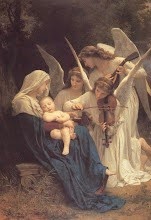
I never realized before reciting the English words of this prayer just how much we us this text in liturgical music. Think about the words as you read over them and try and remember singing them as some time in mass. Then see if you can name some of the tunes to which the text is set in those hymnals of ours.
English
Come O Creator Spirit blest!
And in our souls take up Thy rest;
Come with Thy grace and heavenly aid,
to fill the hearts which Thou hast made
Great Paraclete! To Thee we cry,
O highest gift of God most high!
O font of life! O fire of love!
And sweet anointing from above.
Thou in Thy Sevenfold gifts art known
The finger of God's hand we own;
The promise of the Father, Thou!
Who dost the tongue with power endow.
Kindle our senses from above
And make our hearts o'erflow with love;
With patience firm and virtue high
The weakness of our flesh supply.
Far from us drive the foe we dread,
And grant us Thy true peace instead;
So shall we not, with Thee for guide,
Turn from the path of life aside.
Oh, may Thy grace on us bestow
The Father and the Son to know,
And Thee through endless times confessed
of both the eternal Spirit blest.
All glory while the ages run
Be to the Father and the Son
Who rose from death; the same to Thee,
O Holy Spirit, eternally. Amen
Latin
Veni, creátor Spíritus,
mentes tuórum vísita,
imple supérna grátia,
quæ tu creásti péctora.
Qui díceris Paráclitus,
altíssimi donum Dei,
fons vivus, ignis, cáritas,
et spiritális únctio.
Tu septifórmis múnere,
dígitus patérnæ déxteræ,
tu rite promíssum Patris,
sermóne ditans gúttura.
Accénde lumen sénsibus,
infúnde amórem córdibus,
infírma nostri córporis
virtúte firmans pérpeti.
Hostem repéllas lóngius
pacémque dones prótinus;
ductóre sic te prǽvio
vitémus omne nóxium.
Per Te sciámus da Patrem
noscámus atque Fílium,
teque utriúsque Spíritum
credámus omni témpore.
Deo Patri sit glória,
et Fílio, qui a mórtuis
surréxit, ac Paráclito,
in sæculórum sǽcula. Amen.
Saturday, November 7, 2009


Saturday, October 31, 2009
Karl Paulnack's Speech to Boston Conservatory
I'm posting this speech in its entirety because it's one of the strongest affirmations of the value of music I've ever read! These are words to live by, and they couldn't come at a better time.
Welcome address to freshman class at Boston Conservatory given by Karl Paulnack, pianist and director of music division at Boston Conservatory:
"One of my parents' deepest fears, I suspect, is that society would not properly value me as a musician, that I wouldn't be appreciated. I had very good grades in high school, I was good in science and math, and they imagined that as a doctor or a research chemist or an engineer, I might be more appreciated than I would be as a musician. I still remember my mother's remark when I announced my decision to apply to music school-she said, "You're WASTING your SAT scores." On some level, I think, my parents were not sure themselves what the value of music was, what its purpose was. And they LOVED music, they listened to classical music all the time. They just weren't really clear about its function. So let me talk about that a little bit, because we live in a society that puts music in the "arts and entertainment" section of the newspaper, and serious music, the kind your kids are about to engage in, has absolutely nothing whatsoever to do with entertainment, in fact it's the opposite of entertainment. Let me talk a little bit about music, and how it works.
The first people to understand how music really works were the ancient Greeks. And this is going to fascinate you; the Greeks said that music and astronomy were two sides of the same coin. Astronomy was seen as the study of relationships between observable, permanent, external objects, and music was seen as the study of relationships between invisible, internal, hidden objects. Music has a way of finding the big, invisible moving pieces inside our hearts and souls and helping us figure out the position of things inside us. Let me give you some examples of how this works.
One of the most profound musical compositions of all time is the Quartet for the End of Time written by French composer Olivier Messiaen in 1940. Messiaen was 31 years old when France entered the war against Nazi Germany. He was captured by the Germans in June of 1940, sent across Germany in a cattle car and imprisoned in a concentration camp.
He was fortunate to find a sympathetic prison guard who gave him paper and a place to compose. There were three other musicians in the camp, a cellist, a violinist, and a clarinetist, and Messiaen wrote his quartet with these specific players in mind. It was performed in January 1941 for four thousand prisoners and guards in the prison camp. Today it is one of the most famous masterworks in the repertoire.
Given what we have since learned about life in the concentration camps, why would anyone in his right mind waste time and energy writing or playing music? There was barely enough energy on a good day to find food and water, to avoid a beating, to stay warm, to escape torture-why would anyone bother with music? And yet-from the camps, we have poetry, we have music, we have visual art; it wasn't just this one fanatic Messiaen; many, many people created art. Why? Well, in a place where people are only focused on survival, on the bare necessities, the obvious conclusion is that art must be, somehow, essential for life. The camps were without money, without hope, without commerce, without recreation, without basic respect, but they were not without art. Art is part of survival; art is part of the human spirit, an unquenchable expression of who we are. Art is one of the ways in which we say, "I am alive, and my life has meaning."
On September 12, 2001 I was a resident of Manhattan. That morning I reached a new understanding of my art and its relationship to the world. I sat down at the piano that morning at 10 AM to practice as was my daily routine; I did it by force of habit, without thinking about it. I lifted the cover on the keyboard, and opened my music, and put my hands on the keys and took my hands off the keys. And I sat there and thought, does this even matter? Isn't this completely irrelevant? Playing the piano right now, given what happened in this city yesterday, seems silly, absurd, irreverent, pointless. Why am I here? What place has a musician in this moment in time? Who needs a piano player right now? I was completely lost.
And then I, along with the rest of New York, went through the journey of getting through that week. I did not play the piano that day, and in fact I contemplated briefly whether I would ever want to play the piano again. And then I observed how we got through the day.
At least in my neighborhood, we didn't shoot hoops or play Scrabble. We didn't play cards to pass the time, we didn't watch TV, we didn't shop, we most certainly did not go to the mall. The first organized activity that I saw in New York, that same day, was singing. People sang. People sang around fire houses, people sang "We Shall Overcome". Lots of people sang America the Beautiful. The first organized public event that I remember was the Brahms Requiem, later that week, at Lincoln Center, with the New York Philharmonic. The first organized public expression of grief, our first communal response to that historic event, was a concert. That was the beginning of a sense that life might go on. The US Military secured the airspace, but recovery was led by the arts, and by music in particular, that very night.
From these two experiences, I have come to understand that music is not part of "arts and entertainment" as the newspaper section would have us believe. It's not a luxury, a lavish thing that we fund from leftovers of our budgets, not a plaything or an amusement or a pass time. Music is a basic need of human survival. Music is one of the ways we make sense of our lives, one of the ways in which we express feelings when we have no words, a way for us to understand things with our hearts when we can't with our minds.
Some of you may know Samuel Barber's heartwrenchingly beautiful piece Adagio for Strings. If you don't know it by that name, then some of you may know it as the background music which accompanied the Oliver Stone movie Platoon, a film about the Vietnam War. If you know that piece of music either way, you know it has the ability to crack your heart open like a walnut; it can make you cry over sadness you didn't know you had. Music can slip beneath our conscious reality to get at what's really going on inside us the way a good therapist does.
I bet that you have never been to a wedding where there was absolutely no music. There might have been only a little music, there might have been some really bad music, but I bet you there was some music. And something very predictable happens at weddings-people get all pent up with all kinds of emotions, and then there's some musical moment where the action of the wedding stops and someone sings or plays the flute or something. And even if the music is lame, even if the quality isn't good, predictably 30 or 40 percent of the people who are going to cry at a wedding cry a couple of moments after the music starts. Why? The Greeks. Music allows us to move around those big invisible pieces of ourselves and rearrange our insides so that we can express what we feel even when we can't talk about it. Can you imagine watching Indiana Jones or Superman or Star Wars with the dialogue but no music? What is it about the music swelling up at just the right moment in ET so that all the softies in the audience start crying at exactly the same moment? I guarantee you if you showed the movie with the music stripped out, it wouldn't happen that way. The Greeks: Music is the understanding of the relationship between invisible internal objects.
I'll give you one more example, the story of the most important concert of my life. I must tell you I have played a little less than a thousand concerts in my life so far. I have played in places that I thought were important. I like playing in Carnegie Hall; I enjoyed playing in Paris; it made me very happy to please the critics in St. Petersburg. I have played for people I thought were important; music critics of major newspapers, foreign heads of state. The most important concert of my entire life took place in a nursing home in Fargo, ND, about 4 years ago.
I was playing with a very dear friend of mine who is a violinist. We began, as we often do, with Aaron Copland's Sonata, which was written during World War II and dedicated to a young friend of Copland's, a young pilot who was shot down during the war. Now we often talk to our audiences about the pieces we are going to play rather than providing them with written program notes. But in this case, because we began the concert with this piece, we decided to talk about the piece later in the program and to just come out and play the music without explanation.
Midway through the piece, an elderly man seated in a wheelchair near the front of the concert hall began to weep. This man, whom I later met, was clearly a soldier-even in his 70's, it was clear from his buzz-cut hair, square jaw and general demeanor that he had spent a good deal of his life in the military. I thought it a little bit odd that someone would be moved to tears by that particular movement of that particular piece, but it wasn't the first time I've heard crying in a concert and we went on with the concert and finished the piece.
When we came out to play the next piece on the program, we decided to talk about both the first and second pieces, and we described the circumstances in which the Copland was written and mentioned its dedication to a downed pilot. The man in the front of the audience became so disturbed that he had to leave the auditorium. I honestly figured that we would not see him again, but he did come backstage afterwards, tears and all, to explain himself.
What he told us was this: "During World War II, I was a pilot, and I was in an aerial combat situation where one of my team's planes was hit. I watched my friend bail out, and watched his parachute open, but the Japanese planes which had engaged us returned and machine gunned across the parachute chords so as to separate the parachute from the pilot, and I watched my friend drop away into the ocean, realizing that he was lost. I have not thought about this for many years, but during that first piece of music you played, this memory returned to me so vividly that it was as though I was reliving it. I didn't understand why this was happening, why now, but then when you came out to explain that this piece of music was written to commemorate a lost pilot, it was a little more than I could handle. How does the music do that? How did it find those feelings and those memories in me?
Remember the Greeks: music is the study of invisible relationships between internal objects. This concert in Fargo was the most important work I have ever done. For me to play for this old soldier and help him connect, somehow, with Aaron Copland, and to connect their memories of their lost friends, to help him remember and mourn his friend, this is my work. This is why music matters.
What follows is part of the talk I will give to this year's freshman class when I welcome them a few days from now. The responsibility I will charge your sons and daughters with is this:
"If we were a medical school, and you were here as a med student practicing appendectomies, you'd take your work very seriously because you would imagine that some night at two AM someone is going to waltz into your emergency room and you're going to have to save their life. Well, my friends, someday at 8 PM someone is going to walk into your concert hall and bring you a mind that is confused, a heart that is overwhelmed, a soul that is weary. Whether they go out whole again will depend partly on how well you do your craft.
You're not here to become an entertainer, and you don't have to sell yourself. The truth is you don't have anything to sell; being a musician isn't about dispensing a product, like selling used Chevies. I'm not an entertainer; I'm a lot closer to a paramedic, a firefighter, a rescue worker. You're here to become a sort of therapist for the human soul, a spiritual version of a chiropractor, physical therapist, someone who works with our insides to see if they get things to line up, to see if we can come into harmony with ourselves and be healthy and happy and well.
Frankly, ladies and gentlemen, I expect you not only to master music; I expect you to save the planet. If there is a future wave of wellness on this planet, of harmony, of peace, of an end to war, of mutual understanding, of equality, of fairness, I don't expect it will come from a government, a military force or a corporation. I no longer even expect it to come from the religions of the world, which together seem to have brought us as much war as they have peace. If there is a future of peace for humankind, if there is to be an understanding of how these invisible, internal things should fit together, I expect it will come from the artists, because that's what we do. As in the concentration camp and the evening of 9/11, the artists are the
ones who might be able to help us with our internal, invisible lives."
Welcome address to freshman class at Boston Conservatory given by Karl Paulnack, pianist and director of music division at Boston Conservatory:
"One of my parents' deepest fears, I suspect, is that society would not properly value me as a musician, that I wouldn't be appreciated. I had very good grades in high school, I was good in science and math, and they imagined that as a doctor or a research chemist or an engineer, I might be more appreciated than I would be as a musician. I still remember my mother's remark when I announced my decision to apply to music school-she said, "You're WASTING your SAT scores." On some level, I think, my parents were not sure themselves what the value of music was, what its purpose was. And they LOVED music, they listened to classical music all the time. They just weren't really clear about its function. So let me talk about that a little bit, because we live in a society that puts music in the "arts and entertainment" section of the newspaper, and serious music, the kind your kids are about to engage in, has absolutely nothing whatsoever to do with entertainment, in fact it's the opposite of entertainment. Let me talk a little bit about music, and how it works.
The first people to understand how music really works were the ancient Greeks. And this is going to fascinate you; the Greeks said that music and astronomy were two sides of the same coin. Astronomy was seen as the study of relationships between observable, permanent, external objects, and music was seen as the study of relationships between invisible, internal, hidden objects. Music has a way of finding the big, invisible moving pieces inside our hearts and souls and helping us figure out the position of things inside us. Let me give you some examples of how this works.
One of the most profound musical compositions of all time is the Quartet for the End of Time written by French composer Olivier Messiaen in 1940. Messiaen was 31 years old when France entered the war against Nazi Germany. He was captured by the Germans in June of 1940, sent across Germany in a cattle car and imprisoned in a concentration camp.
He was fortunate to find a sympathetic prison guard who gave him paper and a place to compose. There were three other musicians in the camp, a cellist, a violinist, and a clarinetist, and Messiaen wrote his quartet with these specific players in mind. It was performed in January 1941 for four thousand prisoners and guards in the prison camp. Today it is one of the most famous masterworks in the repertoire.
Given what we have since learned about life in the concentration camps, why would anyone in his right mind waste time and energy writing or playing music? There was barely enough energy on a good day to find food and water, to avoid a beating, to stay warm, to escape torture-why would anyone bother with music? And yet-from the camps, we have poetry, we have music, we have visual art; it wasn't just this one fanatic Messiaen; many, many people created art. Why? Well, in a place where people are only focused on survival, on the bare necessities, the obvious conclusion is that art must be, somehow, essential for life. The camps were without money, without hope, without commerce, without recreation, without basic respect, but they were not without art. Art is part of survival; art is part of the human spirit, an unquenchable expression of who we are. Art is one of the ways in which we say, "I am alive, and my life has meaning."
On September 12, 2001 I was a resident of Manhattan. That morning I reached a new understanding of my art and its relationship to the world. I sat down at the piano that morning at 10 AM to practice as was my daily routine; I did it by force of habit, without thinking about it. I lifted the cover on the keyboard, and opened my music, and put my hands on the keys and took my hands off the keys. And I sat there and thought, does this even matter? Isn't this completely irrelevant? Playing the piano right now, given what happened in this city yesterday, seems silly, absurd, irreverent, pointless. Why am I here? What place has a musician in this moment in time? Who needs a piano player right now? I was completely lost.
And then I, along with the rest of New York, went through the journey of getting through that week. I did not play the piano that day, and in fact I contemplated briefly whether I would ever want to play the piano again. And then I observed how we got through the day.
At least in my neighborhood, we didn't shoot hoops or play Scrabble. We didn't play cards to pass the time, we didn't watch TV, we didn't shop, we most certainly did not go to the mall. The first organized activity that I saw in New York, that same day, was singing. People sang. People sang around fire houses, people sang "We Shall Overcome". Lots of people sang America the Beautiful. The first organized public event that I remember was the Brahms Requiem, later that week, at Lincoln Center, with the New York Philharmonic. The first organized public expression of grief, our first communal response to that historic event, was a concert. That was the beginning of a sense that life might go on. The US Military secured the airspace, but recovery was led by the arts, and by music in particular, that very night.
From these two experiences, I have come to understand that music is not part of "arts and entertainment" as the newspaper section would have us believe. It's not a luxury, a lavish thing that we fund from leftovers of our budgets, not a plaything or an amusement or a pass time. Music is a basic need of human survival. Music is one of the ways we make sense of our lives, one of the ways in which we express feelings when we have no words, a way for us to understand things with our hearts when we can't with our minds.
Some of you may know Samuel Barber's heartwrenchingly beautiful piece Adagio for Strings. If you don't know it by that name, then some of you may know it as the background music which accompanied the Oliver Stone movie Platoon, a film about the Vietnam War. If you know that piece of music either way, you know it has the ability to crack your heart open like a walnut; it can make you cry over sadness you didn't know you had. Music can slip beneath our conscious reality to get at what's really going on inside us the way a good therapist does.
I bet that you have never been to a wedding where there was absolutely no music. There might have been only a little music, there might have been some really bad music, but I bet you there was some music. And something very predictable happens at weddings-people get all pent up with all kinds of emotions, and then there's some musical moment where the action of the wedding stops and someone sings or plays the flute or something. And even if the music is lame, even if the quality isn't good, predictably 30 or 40 percent of the people who are going to cry at a wedding cry a couple of moments after the music starts. Why? The Greeks. Music allows us to move around those big invisible pieces of ourselves and rearrange our insides so that we can express what we feel even when we can't talk about it. Can you imagine watching Indiana Jones or Superman or Star Wars with the dialogue but no music? What is it about the music swelling up at just the right moment in ET so that all the softies in the audience start crying at exactly the same moment? I guarantee you if you showed the movie with the music stripped out, it wouldn't happen that way. The Greeks: Music is the understanding of the relationship between invisible internal objects.
I'll give you one more example, the story of the most important concert of my life. I must tell you I have played a little less than a thousand concerts in my life so far. I have played in places that I thought were important. I like playing in Carnegie Hall; I enjoyed playing in Paris; it made me very happy to please the critics in St. Petersburg. I have played for people I thought were important; music critics of major newspapers, foreign heads of state. The most important concert of my entire life took place in a nursing home in Fargo, ND, about 4 years ago.
I was playing with a very dear friend of mine who is a violinist. We began, as we often do, with Aaron Copland's Sonata, which was written during World War II and dedicated to a young friend of Copland's, a young pilot who was shot down during the war. Now we often talk to our audiences about the pieces we are going to play rather than providing them with written program notes. But in this case, because we began the concert with this piece, we decided to talk about the piece later in the program and to just come out and play the music without explanation.
Midway through the piece, an elderly man seated in a wheelchair near the front of the concert hall began to weep. This man, whom I later met, was clearly a soldier-even in his 70's, it was clear from his buzz-cut hair, square jaw and general demeanor that he had spent a good deal of his life in the military. I thought it a little bit odd that someone would be moved to tears by that particular movement of that particular piece, but it wasn't the first time I've heard crying in a concert and we went on with the concert and finished the piece.
When we came out to play the next piece on the program, we decided to talk about both the first and second pieces, and we described the circumstances in which the Copland was written and mentioned its dedication to a downed pilot. The man in the front of the audience became so disturbed that he had to leave the auditorium. I honestly figured that we would not see him again, but he did come backstage afterwards, tears and all, to explain himself.
What he told us was this: "During World War II, I was a pilot, and I was in an aerial combat situation where one of my team's planes was hit. I watched my friend bail out, and watched his parachute open, but the Japanese planes which had engaged us returned and machine gunned across the parachute chords so as to separate the parachute from the pilot, and I watched my friend drop away into the ocean, realizing that he was lost. I have not thought about this for many years, but during that first piece of music you played, this memory returned to me so vividly that it was as though I was reliving it. I didn't understand why this was happening, why now, but then when you came out to explain that this piece of music was written to commemorate a lost pilot, it was a little more than I could handle. How does the music do that? How did it find those feelings and those memories in me?
Remember the Greeks: music is the study of invisible relationships between internal objects. This concert in Fargo was the most important work I have ever done. For me to play for this old soldier and help him connect, somehow, with Aaron Copland, and to connect their memories of their lost friends, to help him remember and mourn his friend, this is my work. This is why music matters.
What follows is part of the talk I will give to this year's freshman class when I welcome them a few days from now. The responsibility I will charge your sons and daughters with is this:
"If we were a medical school, and you were here as a med student practicing appendectomies, you'd take your work very seriously because you would imagine that some night at two AM someone is going to waltz into your emergency room and you're going to have to save their life. Well, my friends, someday at 8 PM someone is going to walk into your concert hall and bring you a mind that is confused, a heart that is overwhelmed, a soul that is weary. Whether they go out whole again will depend partly on how well you do your craft.
You're not here to become an entertainer, and you don't have to sell yourself. The truth is you don't have anything to sell; being a musician isn't about dispensing a product, like selling used Chevies. I'm not an entertainer; I'm a lot closer to a paramedic, a firefighter, a rescue worker. You're here to become a sort of therapist for the human soul, a spiritual version of a chiropractor, physical therapist, someone who works with our insides to see if they get things to line up, to see if we can come into harmony with ourselves and be healthy and happy and well.
Frankly, ladies and gentlemen, I expect you not only to master music; I expect you to save the planet. If there is a future wave of wellness on this planet, of harmony, of peace, of an end to war, of mutual understanding, of equality, of fairness, I don't expect it will come from a government, a military force or a corporation. I no longer even expect it to come from the religions of the world, which together seem to have brought us as much war as they have peace. If there is a future of peace for humankind, if there is to be an understanding of how these invisible, internal things should fit together, I expect it will come from the artists, because that's what we do. As in the concentration camp and the evening of 9/11, the artists are the
ones who might be able to help us with our internal, invisible lives."
Thursday, October 29, 2009
Aristotle and Catholicism- Pt 1
On the Soul
After presenting the views of previous thinkers, Aristotle proceeded to develop his own theory in the rest of the work. Aristotle's arguments rest on a handful of concepts that are central, not only to the Physics, but to the rest of his philosophy. One is his distinction between Matter and Form. Applied to this subject, Aristotle would call the body matter and the soul the form; they therefore are indivisibly linked as potentiality and actuality. A second concerns his theory of sense perception in which the process is described as receiving in the sense organs of the perceiver "sensible forms" thrown off by the objects of perception. A third is his distinction between the active and the passive intellects. As Aristotle focuses more on the first of these points, so shall I. After arguing that the soul is a substance in the sense of Form, he gives his definition of soul; "the first actuality (entelechy) of a natural body with organs." While this implies that there is a profound unity between soul and body, Aristotle does not provide us with any idea of if they are at all distinct or separate. What he does do is distinguish the various faculties of the soul; the nutritive, perceptive, and intellective faculties. These together with movement create his definition of an animal. There is, however a hierarchy among the faculties of the soul and the soul of the plant differs from that of an animal or man only to the extent that it possess or does not posses these qualities.
Now that a summary of Aristotle's opinions on the soul has been presented, it is necessary and proper for us to consider how his concepts coincide or differ to the traditional Catholic idea of the soul. As far as the Soul is the Form of the body, Aristotle is in complete union with Catholic teaching. The Catechism of the Catholic Church declares in paragraph 365 "The unity of soul and body is so profound that one has to consider the soul to be the 'form' of the body: i.e., it is because of its spiritual soul that the body made of matter becomes a living, human body, spirit and matter, in man, are not two natures united, but rather their union forms a single nature." A single nature, that is the key phrase. There is no duality here (which is a heresy, btw), which was advocated so strongly by Plato, but rather Aristotle calls the soul the actuality of the body, which is to say that the body has forms which are potential in it, i.e., dead or alive, and that the soul is the actualized form of alive of the body.
But this sounds suspiciously like Aristotle is just speaking about life in general. We are free to infer from him what we will about immortality, and it would even be plausible to say that the Soul ceases to exist after the body ceases to exist, as it is absurd to speak of potential energy in a non-existing system, so it is to speak of a soul for a non-existing body. This will require more thought and much deliberation, but at a later date.
After presenting the views of previous thinkers, Aristotle proceeded to develop his own theory in the rest of the work. Aristotle's arguments rest on a handful of concepts that are central, not only to the Physics, but to the rest of his philosophy. One is his distinction between Matter and Form. Applied to this subject, Aristotle would call the body matter and the soul the form; they therefore are indivisibly linked as potentiality and actuality. A second concerns his theory of sense perception in which the process is described as receiving in the sense organs of the perceiver "sensible forms" thrown off by the objects of perception. A third is his distinction between the active and the passive intellects. As Aristotle focuses more on the first of these points, so shall I. After arguing that the soul is a substance in the sense of Form, he gives his definition of soul; "the first actuality (entelechy) of a natural body with organs." While this implies that there is a profound unity between soul and body, Aristotle does not provide us with any idea of if they are at all distinct or separate. What he does do is distinguish the various faculties of the soul; the nutritive, perceptive, and intellective faculties. These together with movement create his definition of an animal. There is, however a hierarchy among the faculties of the soul and the soul of the plant differs from that of an animal or man only to the extent that it possess or does not posses these qualities.
Now that a summary of Aristotle's opinions on the soul has been presented, it is necessary and proper for us to consider how his concepts coincide or differ to the traditional Catholic idea of the soul. As far as the Soul is the Form of the body, Aristotle is in complete union with Catholic teaching. The Catechism of the Catholic Church declares in paragraph 365 "The unity of soul and body is so profound that one has to consider the soul to be the 'form' of the body: i.e., it is because of its spiritual soul that the body made of matter becomes a living, human body, spirit and matter, in man, are not two natures united, but rather their union forms a single nature." A single nature, that is the key phrase. There is no duality here (which is a heresy, btw), which was advocated so strongly by Plato, but rather Aristotle calls the soul the actuality of the body, which is to say that the body has forms which are potential in it, i.e., dead or alive, and that the soul is the actualized form of alive of the body.
But this sounds suspiciously like Aristotle is just speaking about life in general. We are free to infer from him what we will about immortality, and it would even be plausible to say that the Soul ceases to exist after the body ceases to exist, as it is absurd to speak of potential energy in a non-existing system, so it is to speak of a soul for a non-existing body. This will require more thought and much deliberation, but at a later date.
The Prayer of Humility
O Jesus, Meek and Humble of Heart
Hear me
From the desire of being esteemed,
Deliver me, O Jesus.
From the desire of being loved,
Deliver me, O Jesus.
From the desire of being extolled,
Deliver me, O Jesus.
From the desire of being honored,
Deliver me, O Jesus.
From the desire of being praised,
Deliver me, O Jesus.
From the desire of being preferred to others,
Deliver me, O Jesus.
From the desire of being consulted,
Deliver me, O Jesus.
From the desire of being approved,
Deliver me, O Jesus.
From the fear of being humiliated,
Deliver me, O Jesus.
From the fear of being despised,
Deliver me, O Jesus.
From the fear of suffering rebukes,
Deliver me, O Jesus.
From the fear of being calumniated,
Deliver me, O Jesus.
From the fear of being forgotten,
Deliver me, O Jesus.
From the fear of being ridiculed,
Deliver me, O Jesus.
From the fear of being wronged,
Deliver me, O Jesus.
From the fear of being suspected,
Deliver me, O Jesus.
That others may be loved more than I,
Jesus, grant me the grace to desire it.
That others may be esteemed more than I,
Jesus, grant me the grace to desire it.
That, in the opinion of the world,
others may increase and I may decrease,
Jesus, grant me the grace to desire it.
That others may be chosen and I set aside,
Jesus, grant me the grace to desire it.
That others may be praised and I go unnoticed,
Jesus, grant me the grace to desire it.
That others may be preferred to me in everything,
Jesus, grant me the grace to desire it.
That others may become holier than I,
provided that I may become as holy as I should,
Jesus, grant me the grace to desire it.
Hear me
From the desire of being esteemed,
Deliver me, O Jesus.
From the desire of being loved,
Deliver me, O Jesus.
From the desire of being extolled,
Deliver me, O Jesus.
From the desire of being honored,
Deliver me, O Jesus.
From the desire of being praised,
Deliver me, O Jesus.
From the desire of being preferred to others,
Deliver me, O Jesus.
From the desire of being consulted,
Deliver me, O Jesus.
From the desire of being approved,
Deliver me, O Jesus.
From the fear of being humiliated,
Deliver me, O Jesus.
From the fear of being despised,
Deliver me, O Jesus.
From the fear of suffering rebukes,
Deliver me, O Jesus.
From the fear of being calumniated,
Deliver me, O Jesus.
From the fear of being forgotten,
Deliver me, O Jesus.
From the fear of being ridiculed,
Deliver me, O Jesus.
From the fear of being wronged,
Deliver me, O Jesus.
From the fear of being suspected,
Deliver me, O Jesus.
That others may be loved more than I,
Jesus, grant me the grace to desire it.
That others may be esteemed more than I,
Jesus, grant me the grace to desire it.
That, in the opinion of the world,
others may increase and I may decrease,
Jesus, grant me the grace to desire it.
That others may be chosen and I set aside,
Jesus, grant me the grace to desire it.
That others may be praised and I go unnoticed,
Jesus, grant me the grace to desire it.
That others may be preferred to me in everything,
Jesus, grant me the grace to desire it.
That others may become holier than I,
provided that I may become as holy as I should,
Jesus, grant me the grace to desire it.
Wednesday, October 28, 2009
The End of the Affair
Pope John Paul II said “Art has a unique capacity to take on or other facet of the [Christian] message, and translate it into colours, shapes, and sounds which nourish the intuition of those who look or listen.” In The End of the Affair, by Graham Greene, the concept of Hell is fully presented to me as a reality of the human condition, not far and removed from us, but here explicitly in our day to day lives. Man lives out Hell as we are, here on earth, though it be a petty imitation of the total deprivation, just as our loves here are petty imitations of the ultimate love caught up in the Beatific Vision. Bendrix's life is a perfect prequel to hell, and the story of a dark and grievous division, man against God. Sheed tells us to approach the mystery of Hell “as a profound mystery- not of God's cruelty but from man's power to hate God.”1 In this, Bendrix and Sarah give us deep insight to the dregs of evil which they embrace, at least for a time, in hatred of God.
The theme of hate is present from the first page of the book, with Bendrix's assertion that “this is a record of hate far more than of love”2, a record of the denial of love. For that is what Bendrix offers God, his hatred, same as Sarah had. Both Sarah and Bendrix try so hard to chase God a away from them, they try to run in the opposite direction, but find themselves haunted by Him at every corner. Bendrix hates God for taking away what he wants most in the world, Sarah, who he is unconsciously substituting in his life for God, the answer to every longing and every thirst he has ever had. Sarah hates God for taking away Bendrix, once she has promised their affair away, howling in misery in many of her diary how much so. What she says in September is amusing to say the least, in its irony. “While I loved Maurice I loved Henry, and now that I'm what they call good I don't love anyone. Least of all you”3 Both Sarah and Bendrix are caught in their self-needs, their self wants, believing themselves sufficient in their corrupt human love, and caught up in a hatred of the one who denies them their fake drug in order for them to realize their need for him. The whole difference, then, between Sarah and Bendrix, is that while Sarah must finally give in to God, and stop running from the ultimate lover, who has her trapped. Sarah is chased away from herself by her vow. She learned what it meant to love when she met Bendrix, and then she was empty, left with nothing but Him. As she says in her diary, “You'd taken my hate like You'd taken my disbelief into Your love, keeping them to sow me later, so that we could both laugh.”4 Sarah deplores her empty self and her falseness with such fervor that she finds herself almost in the opposite of hell. Her life is a living example of purgatory: the experience of pain purging of all that was eroding at her heart. Bendrix is left still defiant and hateful at the end. As he declares at the very end; “O God, You've done enough, You've robbed me of enough. I'm too tired and too old to learn to love, leave me alone forever”5. Why does he condemn himself to misery? Can he not see that his hatred of God is his source of misery? His hatred of God lends itself to hatred of Sarah too, the one he wished to possess, for that is what love is removed from Christ, usage and possession, just as the Wine of the Last Supper, fermented again, becomes the bitter vinegar on Calvary. Bendrix is denied Sarah, and so he hates the God who took her from him. This hatred of God, being as it is a misconception of his own self-sufficiency, reveals the true pettiness and selfishness of his love in how he tries to ruin Sarah after her death. He has to deny her saintliness, believe that “any man could have her”6, to deny his insufficiency, his defeat at the hands of a god whom he has denied. Hatred for God is everywhere in his heart at this point, and where does it lead? Misery, and were he to perish now, ultimate misery.
The doctrine of Hell, presented as it is through Kreeft and Sheed, while insightful and full of Truth, can not compare to the bleakness with which Greene confronts us. No matter how we look at it, if one really reads Greene's words, they must take part in the emptiness of Sarah's desert, the ultimate futility of her flight from God, and the vanity of Bendrix's hatred. There is an aspect, however, which may seem troubling and counter to this thesis. In Sheed, Hell is described as the choice of self-love over God's love, and thus the eternity of separation from love. But Bendrix has God's love, does he not? Bendrix has Sarah's love, and thus he is not cut off from love entirely, and he gives love, even though he tries to hate. But even in this, Bendrix is empty, for he falls into the trap of self-sufficiency. He thinks he has enough love for both their life times, when in truth, he is so pitifully empty. Sarah knew this, and knew that anything in her which was truly beautiful was thanks only to God. Bendrix must be denied everything, all of his self-sufficiency, before he can realize the hell he truly walks and lives and breathes every moment of his life. Such emotion, such passionate anger and hatred confronts the reader in a more manifest way then any intellectual recount or argument for the existence of Hell. Just as sin, when discussed intellectually, removes us from the reality of evil in man's nature, but place a person in Auschwitz, and his objections to man's degradation must fall flat in the wake of lofty and unsubstantial idealism. Truth does not assault us in the sterilized world of logic, though this is a completely valid and helpful method to approach the particulars of the doctrine. To grasp the implications of our human nature, we must see them as they are, face to face.
The reality of hell has always been very far off for me, this naive child, who does not know despair with any sense of eternity. I have never had to confront evil in any gravity beyond personal grudges and petty differences between people, children's quarrels. I never understood how one might actually be in a disposition to deny God, knowing who He is. But this book has brought to my full and complete attention the emptiness of a life lived in an apathetic hatred and denial of God and his love. When I first completed my read through of the book, I curled up on my dorm-room floor, the emptiness of the desert swelling within me, setting a taste of bile in my mouth and unspent tears on my tongue. Hell is an utter emptiness of love, and once the reality is present in the heart, we can not help but be reduced to tears, for man was not made for such, not for himself, which can not satisfy, but for God. Hell is the ultimate sadness, and the living of it here on earth is a deep sorrow, but no reason for despair. Bendrix still has hope, as do all who are still alive, and even more so, as witnessed in his last confession of exhaustion. God will chase us to the ends of the earth to save us from the fate of hell, from apathy as much as from a passionate hatred. Bendrix has hope even now, even now as the arms of God are wrapped so tightly around him he can not breath. Sarah said “I am going to rob you, God, of what you love most in me”7, but she had to concede in the end, too tired to run away at last. Bendrix's desire will not be heeded, for God never leaves us be, till we finally breath our last he will be suffocating us, so that we realize our absolute need for him. Bendrix can not see that even now, God has him. He can not run, only beg to be left alone, like Sarah begged in that church pew, chased down at last.
1.Fulton J. Sheed Theology for Beginners p.171
2.Graham Greene, The End of the Affair p.7
3.Graham Greene, The End of the Affair p.104
4.Graham Greene, The End of the Affair p.113
5.Graham Greene, The End of the Affair p.192
6.Graham Greene, The End of the Affair p.180
7.Graham Greene, The End of the Affair p. 101
The theme of hate is present from the first page of the book, with Bendrix's assertion that “this is a record of hate far more than of love”2, a record of the denial of love. For that is what Bendrix offers God, his hatred, same as Sarah had. Both Sarah and Bendrix try so hard to chase God a away from them, they try to run in the opposite direction, but find themselves haunted by Him at every corner. Bendrix hates God for taking away what he wants most in the world, Sarah, who he is unconsciously substituting in his life for God, the answer to every longing and every thirst he has ever had. Sarah hates God for taking away Bendrix, once she has promised their affair away, howling in misery in many of her diary how much so. What she says in September is amusing to say the least, in its irony. “While I loved Maurice I loved Henry, and now that I'm what they call good I don't love anyone. Least of all you”3 Both Sarah and Bendrix are caught in their self-needs, their self wants, believing themselves sufficient in their corrupt human love, and caught up in a hatred of the one who denies them their fake drug in order for them to realize their need for him. The whole difference, then, between Sarah and Bendrix, is that while Sarah must finally give in to God, and stop running from the ultimate lover, who has her trapped. Sarah is chased away from herself by her vow. She learned what it meant to love when she met Bendrix, and then she was empty, left with nothing but Him. As she says in her diary, “You'd taken my hate like You'd taken my disbelief into Your love, keeping them to sow me later, so that we could both laugh.”4 Sarah deplores her empty self and her falseness with such fervor that she finds herself almost in the opposite of hell. Her life is a living example of purgatory: the experience of pain purging of all that was eroding at her heart. Bendrix is left still defiant and hateful at the end. As he declares at the very end; “O God, You've done enough, You've robbed me of enough. I'm too tired and too old to learn to love, leave me alone forever”5. Why does he condemn himself to misery? Can he not see that his hatred of God is his source of misery? His hatred of God lends itself to hatred of Sarah too, the one he wished to possess, for that is what love is removed from Christ, usage and possession, just as the Wine of the Last Supper, fermented again, becomes the bitter vinegar on Calvary. Bendrix is denied Sarah, and so he hates the God who took her from him. This hatred of God, being as it is a misconception of his own self-sufficiency, reveals the true pettiness and selfishness of his love in how he tries to ruin Sarah after her death. He has to deny her saintliness, believe that “any man could have her”6, to deny his insufficiency, his defeat at the hands of a god whom he has denied. Hatred for God is everywhere in his heart at this point, and where does it lead? Misery, and were he to perish now, ultimate misery.
The doctrine of Hell, presented as it is through Kreeft and Sheed, while insightful and full of Truth, can not compare to the bleakness with which Greene confronts us. No matter how we look at it, if one really reads Greene's words, they must take part in the emptiness of Sarah's desert, the ultimate futility of her flight from God, and the vanity of Bendrix's hatred. There is an aspect, however, which may seem troubling and counter to this thesis. In Sheed, Hell is described as the choice of self-love over God's love, and thus the eternity of separation from love. But Bendrix has God's love, does he not? Bendrix has Sarah's love, and thus he is not cut off from love entirely, and he gives love, even though he tries to hate. But even in this, Bendrix is empty, for he falls into the trap of self-sufficiency. He thinks he has enough love for both their life times, when in truth, he is so pitifully empty. Sarah knew this, and knew that anything in her which was truly beautiful was thanks only to God. Bendrix must be denied everything, all of his self-sufficiency, before he can realize the hell he truly walks and lives and breathes every moment of his life. Such emotion, such passionate anger and hatred confronts the reader in a more manifest way then any intellectual recount or argument for the existence of Hell. Just as sin, when discussed intellectually, removes us from the reality of evil in man's nature, but place a person in Auschwitz, and his objections to man's degradation must fall flat in the wake of lofty and unsubstantial idealism. Truth does not assault us in the sterilized world of logic, though this is a completely valid and helpful method to approach the particulars of the doctrine. To grasp the implications of our human nature, we must see them as they are, face to face.
The reality of hell has always been very far off for me, this naive child, who does not know despair with any sense of eternity. I have never had to confront evil in any gravity beyond personal grudges and petty differences between people, children's quarrels. I never understood how one might actually be in a disposition to deny God, knowing who He is. But this book has brought to my full and complete attention the emptiness of a life lived in an apathetic hatred and denial of God and his love. When I first completed my read through of the book, I curled up on my dorm-room floor, the emptiness of the desert swelling within me, setting a taste of bile in my mouth and unspent tears on my tongue. Hell is an utter emptiness of love, and once the reality is present in the heart, we can not help but be reduced to tears, for man was not made for such, not for himself, which can not satisfy, but for God. Hell is the ultimate sadness, and the living of it here on earth is a deep sorrow, but no reason for despair. Bendrix still has hope, as do all who are still alive, and even more so, as witnessed in his last confession of exhaustion. God will chase us to the ends of the earth to save us from the fate of hell, from apathy as much as from a passionate hatred. Bendrix has hope even now, even now as the arms of God are wrapped so tightly around him he can not breath. Sarah said “I am going to rob you, God, of what you love most in me”7, but she had to concede in the end, too tired to run away at last. Bendrix's desire will not be heeded, for God never leaves us be, till we finally breath our last he will be suffocating us, so that we realize our absolute need for him. Bendrix can not see that even now, God has him. He can not run, only beg to be left alone, like Sarah begged in that church pew, chased down at last.
“Oh no, there ain't no rest for the wicked
Until we close our eyes for good.”
-Cage the Elephant “Ain't no rest for the Wicked”
1.Fulton J. Sheed Theology for Beginners p.171
2.Graham Greene, The End of the Affair p.7
3.Graham Greene, The End of the Affair p.104
4.Graham Greene, The End of the Affair p.113
5.Graham Greene, The End of the Affair p.192
6.Graham Greene, The End of the Affair p.180
7.Graham Greene, The End of the Affair p. 101
Sunday, October 25, 2009
Kreeft on Saints Part 3
Sainthood is God's job description for us. It is the only job in town. It is not an option, something just for „religious people“ (whoever they are). The most important thing in the world to know, therefore, is how to qualify for this job. First, anyone can qualify. Saints are made out of sinners. Only sinners need apply. Second, no one can qualify. No one can make himself a saint. Only God can do it. Out part is to want it, to choose it, to believe it, and to receive it, and to lie there and not wriggle while Doctor God operates on us.
But though we can't do it without God, God won't do it without us. We become saints by willing to. As William Law says, it you stop to consult your own heart in total honesty, you will see that there is one and only one reason why you are not even now a saint: you do not wholly will it. We become saints not by thinking about it, and not (certainly) by writing about it, but simply by doing it. There comes a time when the „how“ question stops and we just do it. If the one we love were ar our door, knocking to come in, would we wonder how the door lock works, and how we could move our muscles to open it?
Saint Francis of Assisi told his monks that if they were in the beatific vision and a tramp knocked at their door asking for a cup of cold water, then turning away from the heavenly vision to help the tramp would be the real heaven, and turning away from the tramp to keep the blissful vision would be turning from God's face. A saint is one who sees who the tramp is: Jesus.
But though we can't do it without God, God won't do it without us. We become saints by willing to. As William Law says, it you stop to consult your own heart in total honesty, you will see that there is one and only one reason why you are not even now a saint: you do not wholly will it. We become saints not by thinking about it, and not (certainly) by writing about it, but simply by doing it. There comes a time when the „how“ question stops and we just do it. If the one we love were ar our door, knocking to come in, would we wonder how the door lock works, and how we could move our muscles to open it?
Saint Francis of Assisi told his monks that if they were in the beatific vision and a tramp knocked at their door asking for a cup of cold water, then turning away from the heavenly vision to help the tramp would be the real heaven, and turning away from the tramp to keep the blissful vision would be turning from God's face. A saint is one who sees who the tramp is: Jesus.
Kreeft on Saints Part 2
What is a saint? A saint is first of all one who knows he is a sinner. A sint knows all the news all the news, both the bad news of sin and the good news of salvatoin. A saint is a true scientists, a true philosopher; a saint knows the Truth. A saint is a seer, one who sees what is there. A saint is a realist.
A saint is also an idealist. A saint embraces heroic suffering out of heroic love. A saint also embraces heroic joy. (This is one of the criteria for canonization: saints must have joy)
A saint is a slave of Christ, a doormat for Christ, a palm branch for Christ's donkey to march on. A saint is also a conqueror greater than Alexander the great, who conquered only the world. A saint conquers himself. What does it profit a man if he conquers the whole world but does not conquer himself?
A saint is so open that he can day, with Paul, „I have learned, in whatever state I am, to be content. I know how to be abased and I know how to abound“ (Phil 4:11-12). A saint marries God „for better or for worse, for richer or for poorer, in sickness and in health, till death“. A saint is also so closed-minded, so determined, so stubborn, that he will die before comprom1ising the Truth, and will write credo in the sand with his own blood as he dies. (One saint actually did this)
A saint is a sworn enemy of the world, the flesh, and the devil. He is locked in mortal combat with principalities and powers. A saint is also a friend and lover of the world. He kisses this sin-cancered world with the tender lips of the God of John 3:26. A saint declares God's open war on this world, sinking the Cross into the enemy-occupied earth like a sword, hilt held by heaven. At the same time he stretches his arms out on that very Cross as if to say, „See? This is how wide my love for you is!“
A saint is Christ's bride, totally attached, faithful, dependent on him. A saint is also totally independent and detached from idols, from other husbands. A saint works amond money, power, pleasure as a married woman works with other men, but will not marry them or even flirt with them.
A saint is higher than anyone else in the world. A saint is the real mountain climber. A saint is also lower than anyone else in the world. Like water, he flows to the lowest places, like Calcutta.
A saint's heart is broken by every little sorrow and every little sin. A saint's heart is also so strong that not even death can break it. It is indestructible just because it is so breakable.
A saint takes his hands off the steering wheel of his life and lets God steer. This is scary, for God is invisible. A saint also has the strongest hands, hands that move through the world. He has feet that know just where to go and that move through the world with a sure sweep.
A saint does not let others play God to him, as the rest of us all do (especially in a democracy). A saint takes his orders from the General, not from the army. A saint also does not play God to others, as the rest of us all do in all societies since Eden, often in subtle ways. But saints are not subtle. Saints are simple
A saint is a little Christ. Not only do we see Christ through his saints, as we see a light through a stained glass window, but we also understand the saints only through Christ, as we understand eggs only through chickens.
The saints are our family. We are one body. They are our legs and we are theirs. As Pascal says, „examples of noble deaths of Spartans and others hardly affect us,...but the example of the deaths of martyers affects us, for they are our members...We do not become rich through seeing a rich stranger, but through seeing a father or husband rich.
Finally, the saints are our destiny, our eschatology:
And when the strife is fierce, the warefare long,
Steals on the ear the distant triumphant song,
And hearts are brave again, and arms are strong,
Alleluia
I get goose bumps whenever I hear that hymn. The echoes of the song that is the saints come from Eden and from heaven, and all human happiness is an echo of that echo. When we suffer, when we despair, when we cry in rage or helplessness, when we are bewildered, bewitched, bedeviled, betrayed, besmirched, and besotted with the weight of the world, we need to listen to that echo from heaven.
The saints are present, not just past. „We are surrounded by so great a cloud of witnesses“ (Heb 12:1) that we are never alone. We are watched and helped. Death is not so wide a river that heavenly hands cannot reach across it.
A saint is also an idealist. A saint embraces heroic suffering out of heroic love. A saint also embraces heroic joy. (This is one of the criteria for canonization: saints must have joy)
A saint is a slave of Christ, a doormat for Christ, a palm branch for Christ's donkey to march on. A saint is also a conqueror greater than Alexander the great, who conquered only the world. A saint conquers himself. What does it profit a man if he conquers the whole world but does not conquer himself?
A saint is so open that he can day, with Paul, „I have learned, in whatever state I am, to be content. I know how to be abased and I know how to abound“ (Phil 4:11-12). A saint marries God „for better or for worse, for richer or for poorer, in sickness and in health, till death“. A saint is also so closed-minded, so determined, so stubborn, that he will die before comprom1ising the Truth, and will write credo in the sand with his own blood as he dies. (One saint actually did this)
A saint is a sworn enemy of the world, the flesh, and the devil. He is locked in mortal combat with principalities and powers. A saint is also a friend and lover of the world. He kisses this sin-cancered world with the tender lips of the God of John 3:26. A saint declares God's open war on this world, sinking the Cross into the enemy-occupied earth like a sword, hilt held by heaven. At the same time he stretches his arms out on that very Cross as if to say, „See? This is how wide my love for you is!“
A saint is Christ's bride, totally attached, faithful, dependent on him. A saint is also totally independent and detached from idols, from other husbands. A saint works amond money, power, pleasure as a married woman works with other men, but will not marry them or even flirt with them.
A saint is higher than anyone else in the world. A saint is the real mountain climber. A saint is also lower than anyone else in the world. Like water, he flows to the lowest places, like Calcutta.
A saint's heart is broken by every little sorrow and every little sin. A saint's heart is also so strong that not even death can break it. It is indestructible just because it is so breakable.
A saint takes his hands off the steering wheel of his life and lets God steer. This is scary, for God is invisible. A saint also has the strongest hands, hands that move through the world. He has feet that know just where to go and that move through the world with a sure sweep.
A saint does not let others play God to him, as the rest of us all do (especially in a democracy). A saint takes his orders from the General, not from the army. A saint also does not play God to others, as the rest of us all do in all societies since Eden, often in subtle ways. But saints are not subtle. Saints are simple
A saint is a little Christ. Not only do we see Christ through his saints, as we see a light through a stained glass window, but we also understand the saints only through Christ, as we understand eggs only through chickens.
The saints are our family. We are one body. They are our legs and we are theirs. As Pascal says, „examples of noble deaths of Spartans and others hardly affect us,...but the example of the deaths of martyers affects us, for they are our members...We do not become rich through seeing a rich stranger, but through seeing a father or husband rich.
Finally, the saints are our destiny, our eschatology:
And when the strife is fierce, the warefare long,
Steals on the ear the distant triumphant song,
And hearts are brave again, and arms are strong,
Alleluia
I get goose bumps whenever I hear that hymn. The echoes of the song that is the saints come from Eden and from heaven, and all human happiness is an echo of that echo. When we suffer, when we despair, when we cry in rage or helplessness, when we are bewildered, bewitched, bedeviled, betrayed, besmirched, and besotted with the weight of the world, we need to listen to that echo from heaven.
The saints are present, not just past. „We are surrounded by so great a cloud of witnesses“ (Heb 12:1) that we are never alone. We are watched and helped. Death is not so wide a river that heavenly hands cannot reach across it.
Subscribe to:
Posts (Atom)